|

Climate Change
Original Location
 |
Global
Warming:
A Chilling
Perspective
|
 A
Brief History of Ice Ages and Warming A
Brief History of Ice Ages and Warming
Causes
of Global Climate Change
Playing
with Numbers
A
Matter of Opinion
Unraveling
the Earth's Temperature Record
Stopping
Climate Change
A Brief History of Ice Ages
and Warming
Global
warming started long before the "Industrial Revolution" and the
invention of the internal combustion engine. Global warming
began 18,000 years ago as the earth started warming its way out
of the Pleistocene Ice Age-- a time when much of North
America, Europe, and Asia lay buried beneath great sheets of
glacial ice.
Earth's climate and the biosphere have
been in constant flux, dominated by ice ages and glaciers
for the past several million years. We are currently enjoying a
temporary reprieve from the deep freeze.
Approximately every 100,000 years
Earth's climate warms up temporarily. These warm periods, called
interglacial periods, appear to last approximately 15,000
to 20,000 years before regressing back to a cold ice age
climate. At year 18,000 and counting our current interglacial
vacation from the Ice Age is much nearer its end than its
beginning.
Global warming during Earth's current
interglacial warm period has greatly altered our
environment and the distribution and diversity of all life. For
example:
 Approximately 15,000 years ago the earth had warmed
sufficiently to halt the advance of glaciers, and sea levels
worldwide began to rise.
Approximately 15,000 years ago the earth had warmed
sufficiently to halt the advance of glaciers, and sea levels
worldwide began to rise.
By 8,000 years ago the land bridge across the Bering Strait
was drowned, cutting off the migration of men and animals to
North America.
Since the end of the Ice Age, Earth's temperature has risen
approximately 16 degrees F and
sea levels have risen a total of 300
feet! Forests
have returned where once there was only ice.
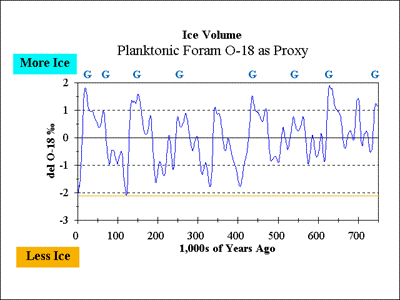
Over the past
750,000 years of Earth's history, Ice Ages have occurred at
regular intervals, of approximately 100,000 years each.
Courtesy of
Illinois State Museum
During
ice ages our planet is cold, dry, and inhospitable--
supporting few forests but plenty of glaciers and
deserts. Like a spread of collosal bulldozers, glaciers have
scraped and pulverized vast stretches of Earth's surface and
completely destroyed entire regional ecosystems not once, but
several times. During Ice Ages winters were longer and more
severe and ice sheets grew to tremendous size, accumulating to
thicknesses of up to 8,000 feet!. They moved slowly from higher
elevations to lower-- driven by gravity and their tremendous
weight. They left in their wake altered river courses, flattened
landscapes, and along the margins of their farthest advance,
great piles of glacial debris.
During the last 3 million years
glaciers have at one time or another covered about 29% of
Earth's land surface or about 17.14 million square miles (44.38
million sq. km.) . What did not
lay beneath ice was a largely cold and desolate desert
landscape, due in large part to the colder, less-humid
atmospheric conditions that prevailed.
During the Ice Age summers were short
and winters were brutal. Animal life and especially plant life
had a very tough time of it. Thanks to global warming, that has
all now changed, at least temporarily.
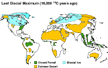
( view full size map) |
The World 18,000 Years
Ago
Before "global warming" started
18,000 years ago most of the earth was a frozen and arid
wasteland. Over half of earth 's surface was covered by
glaciers
or extreme desert.
Forests were rare.
Not a very fun place to live. |
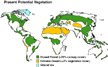
(view full size map) |
Our Present World
"Global warming" over the last
15,000 years has changed our world from an ice box
to a garden. Today
extreme deserts
and glaciers
have largely given way to grasslands, woodlands, and
forests.
Wish it could last forever, but
. . . . |
In
the 1970s concerned environmentalists like Stephen Schneider of
the National Center for Atmospheric Research in Boulder,
Colorado feared a return to another ice age due to
manmade atmospheric pollution blocking out the sun.
Since about 1940 the global climate did
in fact appear to be cooling. Then a funny thing happened--
sometime in the late 1970s temperature declines slowed to a halt
and ground-based recording stations during the 1980s and 1990s
began reading small but steady increases in near-surface
temperatures. Fears of "global
cooling" then changed suddenly
to "global warming,"--
the cited cause:
manmade atmospheric pollution
causing a runaway greenhouse
effect.
What does geologic
history have to offer in sorting through the confusion?
Quite a bit, actually.
 "If
'ice age' is used to refer to long, generally cool, intervals
during which glaciers advance and retreat, we are still in one
today. Our modern climate represents a very short, warm period
between glacial advances."
Illinois State Museum "If
'ice age' is used to refer to long, generally cool, intervals
during which glaciers advance and retreat, we are still in one
today. Our modern climate represents a very short, warm period
between glacial advances."
Illinois State Museum
Periods
of Earth warming and cooling occur in cycles. This is well
understood, as is the fact that small-scale cycles of about 40
years exist within larger-scale cycles of 400 years, which in
turn exist inside still larger scale cycles of 20,000 years, and
so on.
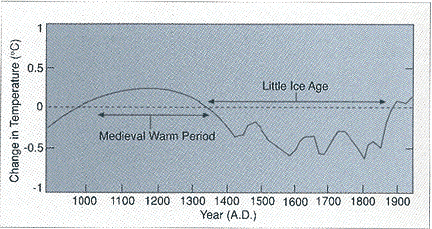
Example of
regional variations in surface air temperature for the last
1000 years, estimated from a variety of sources, including
temperature-sensitive tree growth indices and written
records of various kinds, largely from western Europe and
eastern North America. Shown are changes in regional
temperature in ° C, from the baseline value for 1900.
Compiled by R. S. Bradley and J. A. Eddy based on J. T.
Houghton et al., Climate Change: The IPCC Assessment,
Cambridge UniversityPress, Cambridge, 1990 and published in
EarthQuest, vol 5, no 1, 1991. Courtesy of Thomas Crowley,
Remembrance of Things Past: Greenhouse
Lessons from the Geologic Record
Earth's climate was in a cool period
from A.D. 1400 to about A.D. 1860, dubbed the "Little
Ice Age." This period was
characterized by harsh winters, shorter growing seasons, and a
drier climate. The decline in global temperatures was a modest
1/2° C, but the effects of this global cooling cycle were more
pronounced in the higher latitudes. The Little Ice Age has been
blamed for a host of human suffering including crop failures
like the "Irish Potato Famine" and the demise of the
medieval Viking colonies in Greenland.
Today we enjoy global temperatures
which have warmed back to levels of the so called "Medieval
Warm Period," which existed
from approximately A.D. 1000 to A.D. 1350.
"...the Earth was evidently coming out of a relatively cold
period in the 1800s so that warming in the past century may be
part of this natural recovery."
Dr. John R. Christy
(leading climate and atmospheric science expert- U. of
Alabama in Huntsville) (5)
 Global
warming alarmists maintain that global temperatures have
increased since about A.D. 1860 to the present as the result of
the so-called "Industrial
Revolution,"-- caused by
releases of large amounts of greenhouse gases (principally
carbon dioxide) from manmade sources into the atmosphere
causing a runaway "Greenhouse
Effect." Global
warming alarmists maintain that global temperatures have
increased since about A.D. 1860 to the present as the result of
the so-called "Industrial
Revolution,"-- caused by
releases of large amounts of greenhouse gases (principally
carbon dioxide) from manmade sources into the atmosphere
causing a runaway "Greenhouse
Effect."
Was man really responsible for pulling
the Earth out of the Little Ice Age with his industrial
pollution? If so, this may be one of the greatest unheralded
achievements of the Industrial Age!
Unfortunately, we tend to overestimate
our actual impact on the planet. In this case the magnitude of
the gas emissions involved, even by the most aggressive
estimates of atmospheric warming by greenhouse gases, is
inadequate to account for the magnitude of temperature
increases. So what causes the up and down cycles of global
climate change?
Causes of Global Climate
Change
Climate
change is controlled primarily by cyclical eccentricities in
Earth's rotation and orbit,
as well as variations in the
sun's energy output.
"Greenhouse gases"
in Earth's atmosphere also influence Earth's temperature, but in
a much smaller way. Human additions to total greenhouse gases
play a still smaller role, contributing about
0.2% - 0.3%
to Earth's greenhouse effect.
Major Causes of
Global Temperature Shifts
(1) Astronomical Causes
- 11 year and
206
 year
cycles: Cycles of
solar variability
(
sunspot activity
) year
cycles: Cycles of
solar variability
(
sunspot activity
)
- 21,000 year cycle:
Earth's combined tilt
and elliptical orbit around
the Sun (
precession of the equinoxes
)
- 41,000 year cycle:
Cycle of the +/- 1.5° wobble
in Earth's orbit (
tilt
)
- 100,000 year cycle:
Variations in the shape of
Earth's elliptical orbit (
cycle of eccentricity
)
(2) Atmospheric Causes
- Heat retention:
Due to atmospheric gases, mostly
gaseous water vapor (not droplets), also carbon dioxide,
methane, and a few other miscellaneous gases-- the
"greenhouse effect"
- Solar reflectivity:
Due to
white clouds, volcanic dust, polar ice
caps
(3) Tectonic Causes
- Landmass distribution:
Shifting continents
(continental drift) causing
changes in circulatory patterns of ocean currents. It seems
that whenever there is a large land mass at one of the
Earth's poles, either the north pole or south pole, there
are ice ages.
- Undersea ridge activity: "Sea
floor spreading"
(associated with continental drift) causing variations in
ocean displacement.
-
For more details see:
http://www.ngdc.noaa.gov/paleo/milankovitch.html
http://www.abc.net.au/science/news/enviro/EnviroRepublish_233658.htm
Playing with Numbers
Global
climate and temperature cycles are the result of a complex
interplay between a variety of causes. Because these cycles and
events overlap, sometimes compounding one another, sometimes
canceling one another out, it is inaccurate to imply a
statistically significant trend in climate or temperature
patterns from just a few years or a few decades of data.
Unfortunately, a lot of disinformation
about where Earth's climate is heading is being propagated by
"scientists" who use improper statistical methods, short-term
temperature trends, or faulty computer models to make analytical
and anecdotal projections about the significance of man-made
influences to Earth's climate.
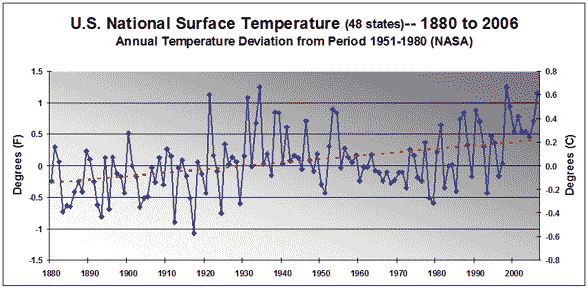
During the last 100 years there have
been two general cycles of
warming and cooling recorded in
the U.S. We are currently in the second warming cycle. Overall,
U.S. temperatures show no
significant warming trend over the last 100 years
(1). This has been well - established but
not well - publicized.
Each year Government press releases
declare the previous year to be the "hottest year on record."
The UN's executive summary on climate
change, issued in January 2001,
insists that the 20th century was the warmest in the last
millennium. The news media distribute these stories and people
generally believed them to be true. However, as most
climatologists know, these reports generally are founded on
ground-based temperature readings, which are misleading. The
more meaningful and precise orbiting satellite data for the same
period (which are generally not cited by the press) have year
after year showed little or no warming.
Dr. Patrick Michaels has demonstrated
this effect is a common problem with ground- based recording
stations, many of which originally were located in predominantly
rural areas, but over time have suffered background bias due to
urban sprawl and the encroachment of concrete and asphalt ( the
"urban heat island effect").
The result has been an upward distortion of increases in ground
temperature over time(2). Satellite measurements are not limited
in this way, and are accurate to within 0.1° C. They are widely
recognized by scientists as the most accurate data available.
Significantly, global
temperature readings from orbiting satellites show no
significant warming in the 18 years they have been continuously
recording and returning data
(1).
A Matter of Opinion
Has
manmade pollution in the form of carbon dioxide (CO2) and other
gases caused a runaway Greenhouse Effect and Global Warming?
Before joining the mantra, consider the
following:
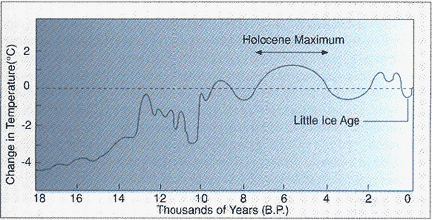
Compiled
by R.S. Bradley and J.A. Eddy based on J.T. Houghton et
al., Climate Change: The IPCC Assessment, Cambridge
University Press, Cambridge, 1990 and published in
EarthQuest, vo. 1, 1991.
Courtesy of Thomas Crowley,
Remembrance of Things Past:
Greenhouse Lessons from the Geologic Record
|
1.
The idea that man-made pollution
is responsible for global warming is not supported by
historical fact. The period known as the Holocene
Maximum is a good example-- so-named because it was
the hottest period in human history. The interesting
thing is this period occurred approximately 7500 to 4000
years B.P. (before present)-- long before humans
invented industrial pollution. |
(view
full-size image)
Figure 1 |
2.
CO2 in our atmosphere has been
increasing steadily for the last 18,000 years-- long
before humans invented smokestacks ( Figure 1).
Unless you count
campfires and intestinal gas, man played no role in the
pre-industrial increases.
As illustrated in this chart of
Ice Core data from the
Soviet Station Vostok in
Antarctica,
CO2 concentrations in earth's
atmosphere move with temperature. Both temperatures and
CO2 have been steadily increasing for 18,000 years.
Ignoring these 18,000 years of data "global warming
activists" contend recent increases in atmospheric CO2
are unnatural and are the result of only 200 years or so
of human pollution causing a runaway greenhouse effect.
Incidentally, earth's
temperature and CO2 levels today have reached levels
similar to a previous interglacial cycle of 120,000 -
140,000 years ago. From beginning to end this cycle
lasted about 20,000 years. This is known as the
Eemian Interglacial Period and the earth returned to
a full-fledged ice age immediately afterward. |
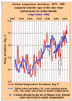
view full-size image
Figure 3 |
4.
If global
warming is caused by CO2 in the atmosphere then does CO2
also cause increased sun activity too?
This chart adapted after
Nigel Calder (6) illustrates that variations in
sun activity are generally proportional to both
variations in atmospheric CO2 and atmospheric
temperature (Figure 3).
Put another way, rising Earth
temperatures and increasing CO2 may be
"effects"
and our own sun the
"cause". |
FUN
FACTS
about CARBON DIOXIDE
Of the 186 billion tons of CO2 that enter earth's atmosphere
each year from all sources, only 6 billion tons are from
human activity. Approximately 90 billion tons come from
biologic activity in earth's oceans and another 90 billion
tons from such sources as volcanoes and decaying land
plants.
At 368 parts per million CO2 is a minor constituent of
earth's atmosphere--
less than 4/100ths of 1% of all gases
present. Compared to former
geologic times, earth's current atmosphere is
CO2- impoverished.
CO2 is odorless, colorless, and tasteless. Plants absorb CO2
and emit oxygen as a waste product. Humans and animals
breathe oxygen and emit CO2 as a waste product. Carbon
dioxide is a nutrient, not a pollutant, and all life--
plants and animals alike-- benefit from more of it. All life
on earth is carbon-based and CO2 is an essential ingredient.
When plant-growers want to stimulate plant growth, they
introduce more carbon dioxide.
CO2 that goes into the atmosphere does not stay there but is
continually recycled by terrestrial plant life and earth's
oceans-- the great retirement home for most terrestrial
carbon dioxide.
If we are in a global
warming crisis today, even the most aggressive and costly
proposals for limiting industrial carbon dioxide emissions
would have a negligible effect on global climate!
The
case for a "greenhouse problem" is made by environmentalists,
news anchormen , and special interests who make inaccurate and
misleading statements about global warming and climate change.
Even though people may be skeptical of such rhetoric initially,
after awhile people start believing it must be true because we
hear it so often.
"We
have to offer up scary scenarios, make simplified, dramatic
statements, and make little mention of any doubts we may have.
Each of us has to decide what the right balance is between being
effective and being honest."
Stephen Schneider (leading
advocate of the global warming theory)
(in interview for Discover magazine, Oct 1989)
"In
the United States...we have to first convince the American
People and the Congress that the climate problem is real."
former President Bill Clinton
in a 1997 address to the United
Nations
Nobody
is interested in solutions if they don't think there's a
problem. Given that starting point, I believe it is appropriate
to have an over-representation of factual presentations on how
dangerous (global warming) is, as a predicate for opening up the
audience to listen to what the solutions are...
former Vice President Al Gore
(now, chairman and co-founder of Generation Investment
Management--
a London-based business that sells carbon credits)
(in interview with
Grist Magazine
May
9, 2006, concerning his book, An Inconvenient Truth)
"In
the long run, the replacement of the precise and disciplined
language of science by the misleading language of litigation and
advocacy may be one of the more important sources of damage to
society incurred in the current debate over global warming."
Dr. Richard S. Lindzen
(leading climate and atmospheric science expert- MIT) (3)
"Researchers pound the global-warming drum
because they know there is politics and, therefore, money behind
it. . . I've been critical of global warming and am persona
non grata."
Dr. William Gray
(Professor of Atmospheric Sciences at Colorado State University,
Fort Collins, Colorado and leading expert of hurricane
prediction )
(in an interview for the Denver Rocky Mountain News,
November 28, 1999)
"Scientists
who want to attract attention to themselves, who want to attract
great funding to themselves, have to (find a) way to scare the
public . . . and this you can achieve only by making things
bigger and more dangerous than they really are."
Petr Chylek
(Professor of Physics and Atmospheric Science, Dalhousie
University, Halifax, Nova Scotia)
Commenting on reports by other researchers that Greenland's
glaciers are melting.
(Halifax Chronicle-Herald, August 22, 2001) (8)
"Even
if the theory of global warming is wrong, we will be doing the
right thing -- in terms of economic policy and environmental
policy."
Tim Wirth , while U.S.
Senator, Colorado.
After a short stint as United Nations Under-Secretary for
Global Affairs (4)
he now serves as President, U.N. Foundation, created by
Ted Turner
and his $1 billion "gift"
"No matter if the science is all phony, there
are collateral environmental benefits.... Climate change
[provides] the greatest chance to bring about justice and
equality in the world."
Christine Stewart,
Minister of the Environment of Canada
recent quote from the Calgary Herald
Unraveling the Earth's
Temperature Record
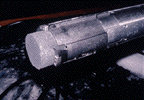
photo by: Vin Morgan
Palaeo Environment (Ice Cores)
Field Work |
Because
accumulating layers of glacial ice display annual bands
which can be dated, similar to annual rings of a tree,
the age of ice core samples can be determined.
Continuous ice cores from borings as much as two miles
long have been extracted from permanent glaciers in
Greenland, Antarctica, and Siberia. Bubbles of entrapped
air in the ice cores can be analyzed to determine not
only carbon dioxide and methane concentrations, but also
atmospheric temperatures can be determined from analysis
of entrapped hydrogen and oxygen. |
Based on historical air temperatures
inferred from ice core analyses from the Antarctic Vostok
station in 1987, relative to the average global temperature in
1900 it has been determined that from 160,000 years ago until
about 18,000 years ago Earth temperatures were on average about
3° C cooler than today.
Except for two relatively brief
interglacial episodes, one peaking about 125,000 years ago
(Eemian Interglacial), and the other beginning about 18,000
years ago (Present Interglacial), the Earth has been under siege
of ice for the last 160,000 years.
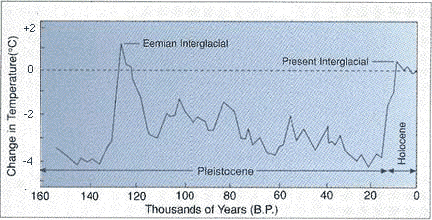
Compiled by
R.S. Bradley and J.A. Eddy based on J. Jouzel et al., Nature
vol. 329. pp. 403-408, 1987 and published in EarthQuest,
vol. 5, no. 1, 1991.
Courtesy of Thomas Crowley,
Remembrance of Things Past: Greenhouse
Lessons from the Geologic Record
As illustrated in this final graph,
over the past 800,000 years the Earth has undergone major swings
in warming and cooling at approximately 100,000 year intervals,
interrupted by minor warming cycles at shorter intervals. This
represents periods of glacial expansion, separated by distinct
but relatively short-lived periods of glacial retreat.
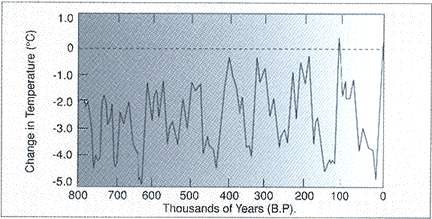
Temperature
data inferred from measurements of the ratio of oxygen
isotope ratios in fossil plankton that settled to the sea
floor, and assumes that changes in global temperature
approximately tracks changes in the global ice volume.
Based on data
from J. Imbrie, J.D. Hays, D.G. Martinson, A. McIntyre, A.C.
Mix, J.J. Morley, N.G. Pisias, W.L. Prell, and N.J.
Shackleton, in A. Berger, J. Imbrie, J. Hats, G. Kukla, and
B. Saltzman, eds., Milankovitch and Climate, Dordrecht,
Reidel, pp. 269-305, 1984.Courtesy of Thomas Crowley,
Remembrance of Things Past: Greenhouse
Lessons from the Geologic Record
The Polar Ice Cap Effect
 As
long as the continent of Antarctica exists at the southern pole
of our planet we probably will be repeatedly
pulled back into glacial ice ages.
This occurs because ice caps, which cannot attain great
thickness over open ocean, can and do achieve great thickness
over a polar continent-- like Antarctica. Antarctica used to be
located near the equator, but over geologic time has moved by
continental drift
to its present location at the south pole. Once established,
continental polar ice caps act like huge cold sinks, taking over
the climate and growing bigger during periods of reduced solar
output. Part of the problem with shaking off the effects of an
ice age is once ice caps are established, they cause solar
radiation to be reflected back into space, which acts to
perpetuate global cooling. This increases the size of ice caps
which results in reflection of even more radiation, resulting in
more cooling, and so on. As
long as the continent of Antarctica exists at the southern pole
of our planet we probably will be repeatedly
pulled back into glacial ice ages.
This occurs because ice caps, which cannot attain great
thickness over open ocean, can and do achieve great thickness
over a polar continent-- like Antarctica. Antarctica used to be
located near the equator, but over geologic time has moved by
continental drift
to its present location at the south pole. Once established,
continental polar ice caps act like huge cold sinks, taking over
the climate and growing bigger during periods of reduced solar
output. Part of the problem with shaking off the effects of an
ice age is once ice caps are established, they cause solar
radiation to be reflected back into space, which acts to
perpetuate global cooling. This increases the size of ice caps
which results in reflection of even more radiation, resulting in
more cooling, and so on.
Continental polar ice caps seem to play
a particularly important role in ice ages when the arrangement
of continental land masses restrict the free global circulation
of equatorial ocean currents. This is the case with the
continents today, as it was during the
Carboniferous Ice Age
when the supercontinent Pangea stretched from pole to
pole 300 million years ago.
Stopping Climate Change
Putting
things in perspective, geologists tell us our present warm
climate is a mere blip in the history of an otherwise cold
Earth. Frigid Ice Age temperatures have been the rule, not the
exception, for the last couple of million years. This kind of
world is not totally inhospitable, but not a very fun place to
live, unless you are a polar bear.
Some say we are
"nearing the end of our minor interglacial
period" , and may in fact be on
the brink of another Ice Age. If this is true, the last thing we
should be doing is limiting carbon dioxide emissions into the
atmosphere, just in case they may have a positive effect in
sustaining present temperatures. The smart money, however, is
betting that there is some momentum left in our present warming
cycle. Environmental advocates agree: resulting in a shift of
tactics from the "global cooling" scare of the 1970s to
the "global warming" threat of the 1980s and 1990s.
Now, as we begin the 21st century the
terminology is morphing toward"climate change," whereby
no matter the direction of temperature trends-- up or down-- the
headlines can universally blame humans while avoiding the
necessity of switching buzz-words with the periodicity of solar
cycles. Such tactics may, however, backfire as peoples' common
sensibilities are at last pushed over the brink.
Global climate cycles of warming and
cooling have been a natural phenomena for hundreds of thousands
of years, and it is unlikely that these cycles of dramatic
climate change will stop anytime soon. We currently enjoy a warm
Earth. Can we count on a warm Earth forever? The answer is most
likely... no.
Since the climate has always been
changing and will likely continue of its own accord to change in
the future, instead of crippling the U.S. economy in order to
achieve small reductions in global warming effects due to
manmade additions to atmospheric carbon dioxide, our resources
may be better spent making preparations to adapt to global
cooling and global warming, and the inevitable consequences of
fluctuating ocean levels, temperatures, and precipitation that
accompany climatic change.
Supporting this view is British
scientist
Jane Francis,
who maintains:
" What we are seeing really is
just another interglacial phase within our big icehouse
climate." Dismissing political calls for a global effort
to reverse climate change, she said, " It's really
farcical because the climate has been changing constantly...
What we should do is be more aware of the fact that it is
changing and that we should be ready to adapt to the
change."

|
 |
|
THIS
PAGE BY:
Monte Hieb
This site last updated
October 5, 2007 |
|
Previous
|
Table of Contents |
|
 ...EMAIL
COMMENTS TO:
mhieb@geocraft.com ...EMAIL
COMMENTS TO:
mhieb@geocraft.com
References
(1)
A scientific Discussion of Climate Change,
Sallie Baliunas, Ph.D., Harvard- Smithsonian Center for
Astrophysics and Willie Soon, Ph.D., Harvard- Smithsonian Center
for Astrophysics.
(2)
The Effects of Proposals for Greenhouse
Gas Emission Reduction;
Testimony of Dr. Patrick J. Michaels, Professor of Environmental
Sciences, University of Virginia, before the Subcommittee on
Energy and Environment of the Committee on Science, United
States House of Representatives
(3)
Statement Concerning Global Warming--
Presented to the Senate Committee on Environmental and Public
Works, June 10, 1997, by Dr. Richard S. Lindzen, Massachusetts
Institute of Technology
(4) Excerpts from,"Our
Global Future: Climate Change",
Remarks by Under Secretary for Global affairs, T. Wirth, 15
September 1997. Site maintained by
The Globe - Climate Change Campaign
(5)
Testimony of John R. Christy
to the Committee on Environmental and Public Works, Department
of Atmospheric Science and Earth System Science Laboratory,
University of Alabama in Huntsville, July 10, 1997.
(6) The Carbon Dioxide
Thermometer and the Cause of Global Warming; Nigel
Calder,-- Presented at a seminar SPRU (Science and Technology
Policy Research), University of Sussex, Brighton, England,
October 6, 1998.
(7) Variation in cosmic ray flux
and global cloud coverage: a missing link in solar-climate
relationships; H. Svensmark and E. Friis-Christiansen,
Journal of Atmospheric and Solar- Terrestrial Physics, vol. 59,
pp. 1225 - 1232 (1997).
(8) First International Conference
on Global Warming and the Next Ice Age; Dalhousie
University, Halifax, Nova Scotia, sponsored by the Canadian
Meteorological and Oceanographic Society and the American
Meteorological Society, August 21-24, 2001.
Additional Reading
Understanding Common Climate Claims:
Dr. Richard S. Lindzen; Draft paper to appear in the Proceedings
of the 2005 Erice Meeting of the World Federation of Scientists
on Global Emergencies.
Geological Constraints on Global Climate
Variability: Dr. Lee C.
Gerhard-- A variety of natural climate drivers constantly change
our climate. A slide format presentation. 8.5 MB.
Thoughts of Global Warming:
"The bottom line is that climatic change is a given. It is
inescapable, it happens. There is no reason to be very concerned
about it or spend bazillions of dollars to try and even things
out.
NOAA Paleoclimatology:
An educational trip through earths distant and recent past. Also
contains useful information and illustrations relating to the
causes of climate change.
Cracking the Ice Age:
From the PBS website-- NOVA online presents a brief tour of the
causes of global warming.
Little Ice Age (Solar Influence -
Temperature): From the online
magazine, "CO2 Science."
Solar Variability and Climate Change:
by Willie Soon, January 10, 2000
Earth's Fidgeting Climate:
NASA Science News "It may surprise many people that science
cannot deliver an unqualified, unanimous answer about something
as important as climate change"
|